This guide is for non-medical home care: personal care, homemaker, companion, and help with daily living. It is not for Medicare-certified home health or hospice, which are different licenses with clinical requirements. Where we cite the rule we mean the text of Part 245 as published; where a number comes from a secondary source or has not been confirmed with IDPH, we say so. Rules change. Confirm the current fee and forms with IDPH's Office of Health Care Regulation before filing.
Which license you need
Part 245 covers three licenses: Home Health (skilled, Medicare), Home Nursing, and Home Services. A non-medical agency needs the Home Services Agency license. There is also a separate "Home Services Placement Agency" license for businesses that refer independent workers to clients rather than employing and supervising caregivers; under §245.214 a placement agency exercises no direction or control over the worker once placed and charges a one-time placement fee. If you intend to employ, train, schedule, and supervise caregivers, you are a Home Services Agency, not a placement agency.
What it costs
| Item | Low | High | Note |
|---|---|---|---|
| IDPH license fee | $1,500 | $1,500 | Annual, non-refundable. Confirm the current schedule with IDPH. |
| Entity formation and legal | $400 | $2,000 | Illinois LLC articles are $150 with the Secretary of State. |
| Liability insurance | $2,500 | $7,500 | Rule requires $1M per occurrence, $3M aggregate (§245.90(a)(2)). |
| Workers' compensation | $1,000 | $4,500 | Required before the first employee. |
| Background checks and registry setup | $800 | $2,500 | Fingerprint-based, per worker. |
| Policies, forms, and compliance | $1,500 | $6,000 | This is the line a launch service replaces. |
| Office, phone, technology | $1,500 | $6,000 | |
| Recruiting and marketing | $2,000 | $8,000 | |
| Payroll float | $20,000 | $50,000+ | You pay caregivers before clients and Medicaid pay you. |
Ranges are compiled from published Illinois startup guides and should be treated as estimates. The one figure that is not an estimate is the insurance minimum, which is in the rule.
The timeline
- Weeks 1 to 3: entity and accounts. Illinois LLC, EIN, Illinois Department of Revenue registration, an unemployment insurance account with IDES before first payroll, workers' compensation, and the liability policy. Use the identical legal name on every one of these. A mismatch between the entity and the license application is a documented way to lose months.
- Weeks 2 to 6: policies, forms, and the application. The application itself requires copies of your policies (§245.90(a)(3)), so the manual comes first. File IDPH Form 445103 with the Certificate of Insurance, your client service contract, a sample service plan, and proof of IDPH Web Portal and Health Care Worker Registry registration.
- Up to 90 days: IDPH review. IDPH says it reviews within 30 days and decides within 90. If approved you receive a provisional license valid 240 days.
- Provisional period: serve clients. You can take private-pay clients on the provisional license. Build the personnel and client files exactly as the rule describes, because the survey will open them.
- Last 30 days of the provisional period: the state survey. An on-site survey before full licensure. Pass it and you hold a full license, renewed annually; the renewal must be filed 60 to 90 days before expiry (§245.90(b)(1)).
Realistically: two to three months to a provisional license on a clean application, private-pay revenue from that point, and roughly ten to eleven months to full licensure.
What the application must contain
From §245.90(a)(3): agency name and address; ownership and governing structure, including alternate administrative staff; the names of anyone owning 5% or more, with conviction disclosures; a description of services; a staff list with qualifications and job descriptions; sources of financing; a service area description or map; charges by service type; copies of your policies on complaint resolution, employee health and safety, infection control, background checks and mandated reporting, supervisory visits, client records, and training; and proof of Web Portal and Registry access. Also attach your client service contract (§245.90(a)(5)) and a sample service plan (§245.90(a)(8)).
The policies the rule requires
A generic template will not survive a survey. These are the policy topics Part 245 names, with the section that names them:
- Administrative policies for safe, adequate client care, adopted by a governing body with bylaws reviewed annually and meeting minutes (§245.30(a), (b)(1)).
- Complaint resolution between the agency and clients (§245.30(b)(3)).
- Personnel policies covering wages, hours and leave; initial health evaluation for anyone with client contact; orientation and continuing education; job descriptions; annual evaluations; civil rights compliance; confidentiality; communicable disease reporting; and in-home safety for staff (§245.30(c)(1)).
- Infection control, at minimum following CDC guidance (§245.75).
- Abuse, neglect, and financial exploitation reporting, with a 14-day written investigation and a copy to IDPH within 24 hours of completion (§245.250).
- A quality improvement program evaluated at least annually, with a quarterly sample review of client records (§245.240).
- Client record retention of at least two years past the last service, and a written confidentiality policy (§245.210(h) to (j)).
- Non-discrimination in accepting clients (§245.210(d)(3)) and discharge with seven working days' written notice and a stated reason (§245.210(d)(4)).
Caregiver requirements and training
- Background checks: every worker with client contact needs a fingerprint-based check through the IDPH Health Care Worker Registry. The agency registers on the IDPH Web Portal first and enters each applicant before fingerprinting.
- Files: Social Security card copy, work authorization, an initial health evaluation, and, for anyone state-licensed, an IDFPR verification printout (§245.71(a), §245.30(c)(2), (c)(3)).
- Initial training: 10 hours. Five hours before the first assignment and five more within 30 days, with a competency evaluation on the first five before any assignment (§245.71(c)). Fourteen required topics, including understanding dementia (§245.71(e)).
- Annual training: 10 hours every year after (§245.71(f)).
- Dementia rule: staff with direct access to clients with Alzheimer's or related dementias need 6 hours within 60 days of hire and 3 hours every year, under 77 Ill. Adm. Code 973.
- Supervision: a supervisor available at all times, a supervisory visit at least every 90 days, and an annual on-site observation of each worker (§245.40(c)(6)). Supervision time is not billable to the client.
- Documentation: every training session logged with date, minutes per topic, instructor qualifications, content, and signature (§245.71(i)).
Client contracts and service plans
The client service contract must be in at least 12-point type and include, per §245.220 and §245.210(c): the client's consent; agency name, address, and phone; the manager's contact; a statement of license status and compliance with the Act; the term; rates and services; how the contract is changed or ended; the complaint process and a contact for concerns; billing and payment terms; the emergency notification policy; and a notice stating who is the employer and who is responsible for wages, taxes, supervision, assignment, hiring and firing, and equipment.
The service plan (§245.210(e)) covers the care regimen, medication reminders, activity, diet, functional limitations, mental health status, visit frequency, equipment, and client limitations. No physician signature is needed, and it is reviewed at least annually. The client record holds identifying information, contacts, the plan, the contract, and a note for every visit.
The survey, and what gets cited
IDPH may inspect, visit clients' homes with their consent, and demand books, records, and policies on request; refusing is itself a violation (§245.110, §245.130(b)(5)). The deficiencies that follow from the rule are predictable: a worker assigned before the five pre-assignment hours and competency evaluation; missing training logs; a supervisory visit outside 90 days; a contract missing a required element; a discharge without seven days' notice; no quarterly record review; an abuse report filed late; a personnel file missing next-of-kin or the separation reason. Run a mock survey against that list before the state does.
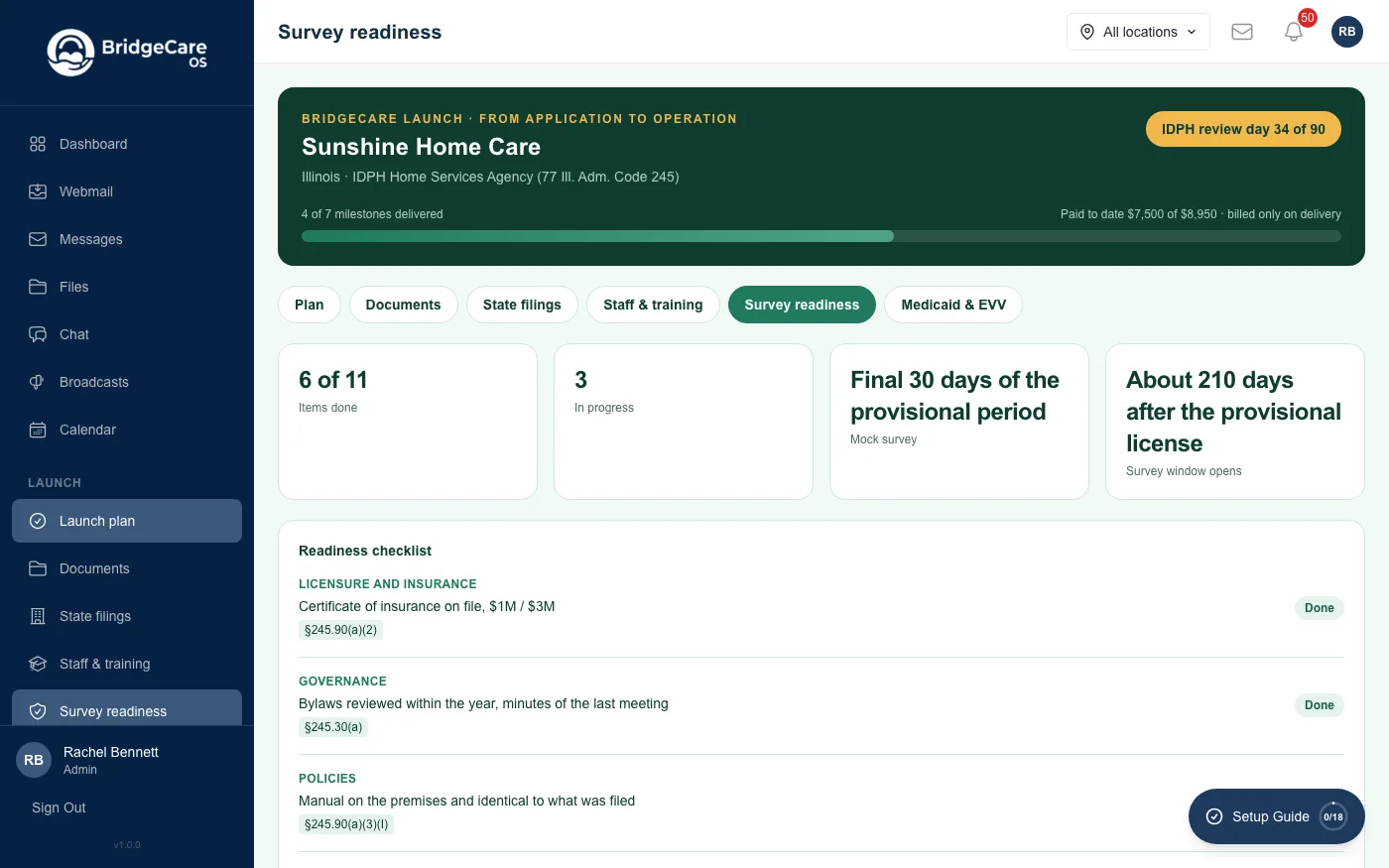
The survey readiness view in BridgeCare Launch, from the live demo agency.
Medicaid: where the real revenue is
- Community Care Program (Illinois Department on Aging): open to any willing and qualified agency, applied for online, and you must also enroll in the state Medicaid system, IMPACT. You cannot be active until IDoA notifies HFS.
- Home Services Program (IDHS): agency providers enroll through the local Division of Rehabilitation Services office.
- Electronic Visit Verification: Illinois uses HHAeXchange, reached through IMPACT enrollment, and it is mandatory before serving Medicaid program participants.
- Managed care: the Medicaid managed care organisations contract separately.
This is the milestone where most timelines slip, and it is the reason to have scheduling, EVV, and billing running before enrollment goes live rather than after.
Mistakes that cost months
- A legal name that differs between the Secretary of State, the IRS, the insurer, and the IDPH application.
- Filing before the policy manual exists, then answering IDPH's request for it weeks later.
- A template manual that never mentions Part 245 by section.
- Hiring a caregiver and sending them to a client before the five-hour pre-assignment training and competency check.
- Paying a consultant a large deposit against months of future work. Illinois owners learned this one in 2026 when a national consultant closed mid-contract.
Doing it with help, priced per milestone
Everything above is what BridgeCare Launch delivers for Illinois: entity and accounts ($650), the Part 245 policy manual and forms ($2,950), the license application submitted and tracked ($2,450), the caregiver onboarding and training system ($1,450), the client contract and service plan ($950), a mock survey ($1,250), and Medicaid, IMPACT, and EVV enrollment ($1,950). $8,950 for all seven, billed only as each one is delivered, and a free written startup plan first. State fees, insurance, and background checks are yours and are itemised in the plan.