What "best billing software" actually means in 2026
Generating an 837P claim is table stakes — every platform here does it. The money an agency actually loses hides in two places that claim generation doesn't touch: denials (claims that bounce because of an EVV gap, an authorization overrun, a coding mismatch, or thin documentation) and unbilled visits (care that was delivered and verified but never made it onto a claim). So we ranked these platforms on six axes weighted toward preventing both:
- Pre-bill denial prevention — Does it audit each visit for denial drivers before the claim is generated, or only scrub the claim file at submission?
- 837P Medicaid claim generation — Native ANSI X12 837P from EVV-verified visits, multi-payer rate schedules, 835 remittance posting.
- Authorization tracking — Authorized-hours and authorization-window enforcement, with overrun and expiry alerts.
- EVV ↔ billing reconciliation — Can it show which verified visits were never billed, and which claims are billed but unpaid?
- Documentation & audit support — Anything that helps defend a visit in an audit, including AI documentation review.
- Total cost & transparency — Published flat pricing vs. quote-only per-client contracts with implementation fees.
The 8 best home care billing platforms in 2026
BridgeCare OS
BridgeCare OS is the only platform on this list that ships a pre-bill denial audit as a standard feature. Its Claim Readiness view scans every completed visit for the gaps that cause denials — EVV completeness, prior-authorization overruns and expiry, service-code-vs-care-plan mismatches, unresolved visit exceptions — and an optional AI review compares each visit note against the care plan for documentation gaps. An EVV-to-billing reconciliation report tracks every visit through submitted → billed → paid, surfacing unbilled visits (lost revenue) and unpaid claims (AR). All of it is included, at transparent flat pricing.
Pros
- Only platform here with a built-in pre-bill denial audit
- AI documentation-gap review (rare in this segment)
- EVV-to-billing reconciliation finds unbilled revenue
- Transparent flat pricing, billing included
Cons
- Newer platform than the enterprise incumbents
- AI review uses your own AI key to enable
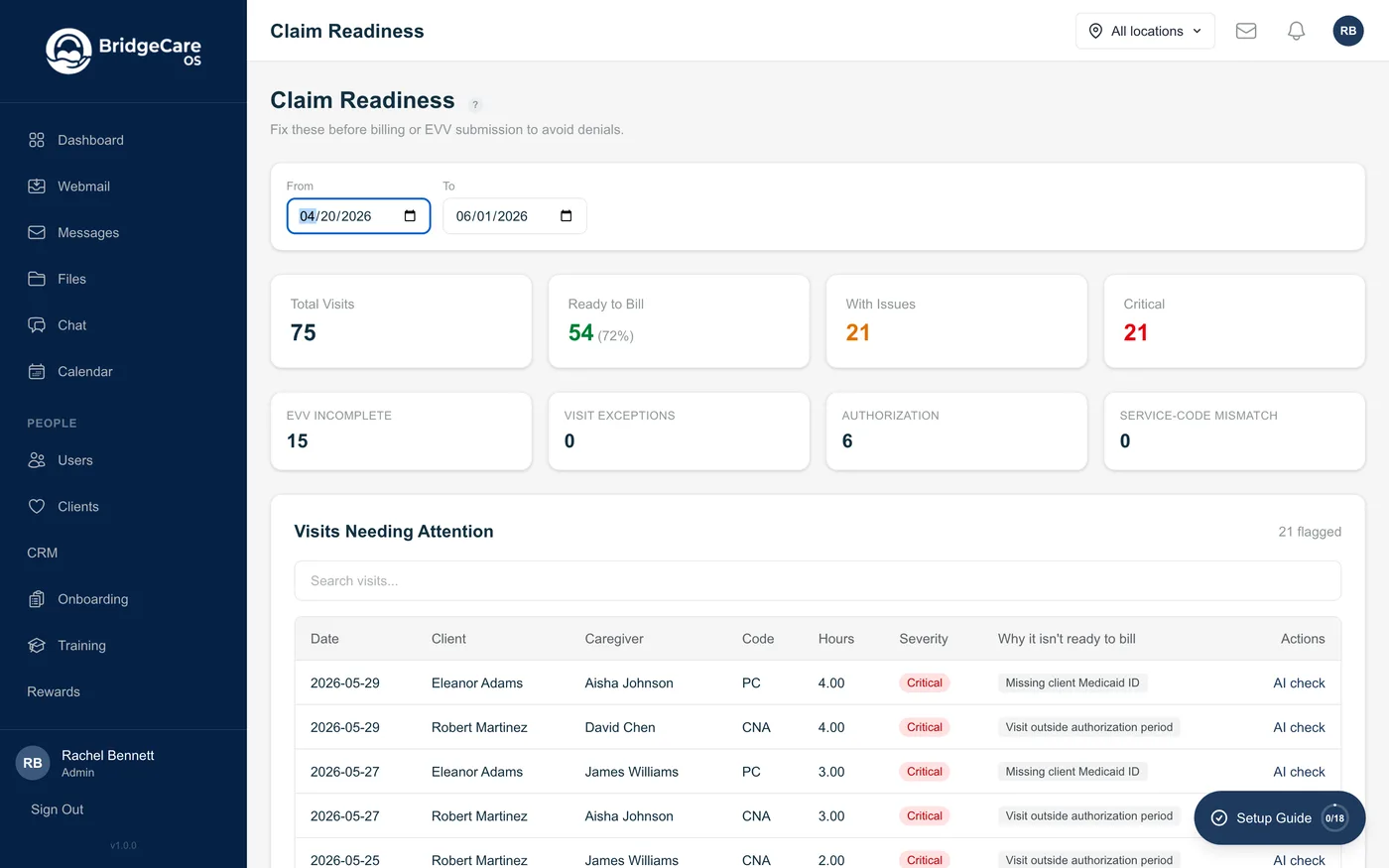
How denial prevention works → · Medicaid billing deep-dive → · See all 11 screens →
WellSky Personal Care
WellSky is the most widely deployed personal-care platform in North America, with deep Medicaid billing and denial-management workflows built over many years. If you're a large or franchise enterprise that needs a mature revenue-cycle operation and has the budget for it, WellSky is the safe incumbent choice. Pricing is quote-only and lands well above the transparent flat-rate platforms.
Pros
- Mature, deeply proven Medicaid billing
- Broad enterprise + franchise adoption
- Comprehensive revenue-cycle tooling
Cons
- Quote-only, enterprise-level pricing
- Heavier to implement than SMB platforms
- No published pricing to evaluate quickly
AlayaCare
AlayaCare pairs clinical documentation with billing and revenue-cycle management, and has invested heavily in analytics and AI. It's a strong fit for larger, multi-region agencies that want clinical depth alongside billing. Like other enterprise platforms, it's quote-only and carries implementation overhead that's hard to justify for a small agency.
Pros
- Clinical + billing depth in one platform
- Strong analytics and multi-region support
Cons
- Enterprise pricing and implementation
- Overkill for small agencies
Axxess
Axxess is strongest for agencies with a significant home-health (clinical) component, with mature OASIS and Medicare/Medicaid billing. Personal-care-only agencies sometimes find it heavier than they need. Pricing is modular, which can mean fee creep as you add capabilities.
Pros
- Deep home-health + OASIS billing
- Established, broad feature set
Cons
- Modular pricing can creep
- Heavier than personal-care-only agencies need
AxisCare
AxisCare is known for a clean, usable interface and solid billing for mid-market personal-care agencies, with EVV included. It covers the billing fundamentals well; it doesn't position a unified pre-bill denial audit or AI documentation review the way BridgeCare OS does.
Pros
- Clean, easy-to-learn interface
- EVV included; solid billing fundamentals
Cons
- Quote-based pricing
- No unified denial-prevention dashboard
CareSmartz360
CareSmartz360 is a capable mid-market platform with EVV and Medicaid billing. Pricing typically scales per active client, which can become unpredictable as your census grows. Good fundamentals; denial prevention is handled through standard scrubbing rather than a pre-bill audit.
Pros
- Solid mid-market feature coverage
- EVV + Medicaid billing included
Cons
- Per-client pricing scales with census
- No pre-bill denial audit
Alora
Alora serves home-health and home-care agencies with billing for both Medicare and Medicaid. It's a reasonable option for agencies that straddle clinical and personal care. Billing is competent; denial prevention is conventional.
Pros
- Handles both home health and home care
- Established billing
Cons
- Interface feels dated
- No standout denial-prevention tooling
Ankota
Ankota focuses on operations and scheduling for home care and is a budget-friendly option. Billing is functional rather than a differentiator, and there's no pre-bill denial audit. Best fit for agencies whose priority is operations rather than revenue-cycle depth.
Pros
- Budget-friendly
- Operations + scheduling focus
Cons
- Billing is not a differentiator
- No denial-prevention tooling
Side-by-side: denial prevention & cost
| Platform | Pre-bill denial audit | AI doc review | EVV↔billing reconciliation | Pricing |
|---|---|---|---|---|
| BridgeCare OS | Yes — every visit | Yes (optional) | Yes — built in | Flat, published |
| WellSky | Scrubbing + denial mgmt | Summarization only | Via reports | Quote-only |
| AlayaCare | Validation + RCM | Analytics | RCM module | Quote-only |
| Axxess | Scrubbing | Limited | Reports | Modular |
| AxisCare | Validation | No | Reports | Quote-based |
| CareSmartz360 | Scrubbing | No | Reports | Per-client |
| Alora | Validation | No | Reports | Quote-based |
| Ankota | Basic | No | Reports | Budget |
Competitor capabilities are summarized from public positioning and may change; verify current details with each vendor. BridgeCare OS rows reflect shipped features.
Frequently asked questions
What is the best home care billing software in 2026?
For most small-to-mid agencies, BridgeCare OS — flat $249-$499/month + $12-$14 per caregiver, native 837P claims, and a built-in pre-bill Claim Readiness audit that catches denial drivers before submission, plus EVV-to-billing reconciliation. WellSky and AlayaCare lead for large enterprises but are quote-only and more expensive.
How do I reduce Medicaid claim denials in home care?
Run a pre-bill audit that checks every completed visit for the common denial drivers — incomplete EVV, authorization overruns, service-code mismatches, unresolved exceptions, and documentation gaps — before the claim is generated, so problems are fixed while they're cheap rather than appealed after denial. BridgeCare OS does this automatically with Claim Readiness, including an optional AI note-vs-care-plan review.
What is a pre-bill claim audit?
It reviews each visit for billability before the claim is generated, rather than discovering problems weeks later at denial. It's deeper than claim scrubbing — scrubbing checks the claim file format at submission, while a pre-bill audit checks the underlying visit data (EVV, authorization usage, care-plan alignment, documentation).
Can AI review home care documentation for billing?
Yes — AI can compare a visit note against the care plan and flag missing or contradictory documentation and audit risk. As of 2026 this is rare in the small-to-mid market; BridgeCare OS includes an optional AI documentation-gap review per visit, where most competitors' AI focuses on document extraction or summarization.
How do I find home care visits I never billed?
Use an EVV-to-billing reconciliation view that tracks each visit through submitted → billed → paid and flags unbilled visits (earned revenue never invoiced) and billed-but-unpaid claims (AR). BridgeCare OS includes this as a standard report.
How much does home care billing software cost in 2026?
Transparent flat-rate platforms publish pricing — BridgeCare OS is $249-$499/month plus $12-$14 per caregiver, billing included. Enterprise platforms (WellSky, AlayaCare, Axxess) are quote-only, often per active client or per user, with implementation fees from several thousand to tens of thousands of dollars.