How we ranked the 10 platforms
Every vendor below is publicly reviewable on G2 or Capterra and has been operating for at least three years. We evaluated each on six axes that map to what actually matters for home care agencies in 2026:
- Total cost of ownership — base subscription, per-caregiver fees, setup fees, contract minimums, hidden upcharges.
- EVV depth — native integrations with Sandata, HHAeXchange, Netsmart, plus state-specific aggregator support.
- Billing & revenue cycle — Medicaid EDI (ANSI X12 837P), multi-payer rates, claim scrubbing, denial management, remittance posting.
- Caregiver mobile UX — clock-in/out, care documentation, shift swaps, messaging — does the field staff actually want to use it.
- Family transparency — does the platform give families visibility into care plans, visits, and updates without a separate add-on.
- Implementation time — how fast a new agency goes from contract signed to running scheduling and EVV.
The 10 best home care software platforms in 2026
BridgeCare OS
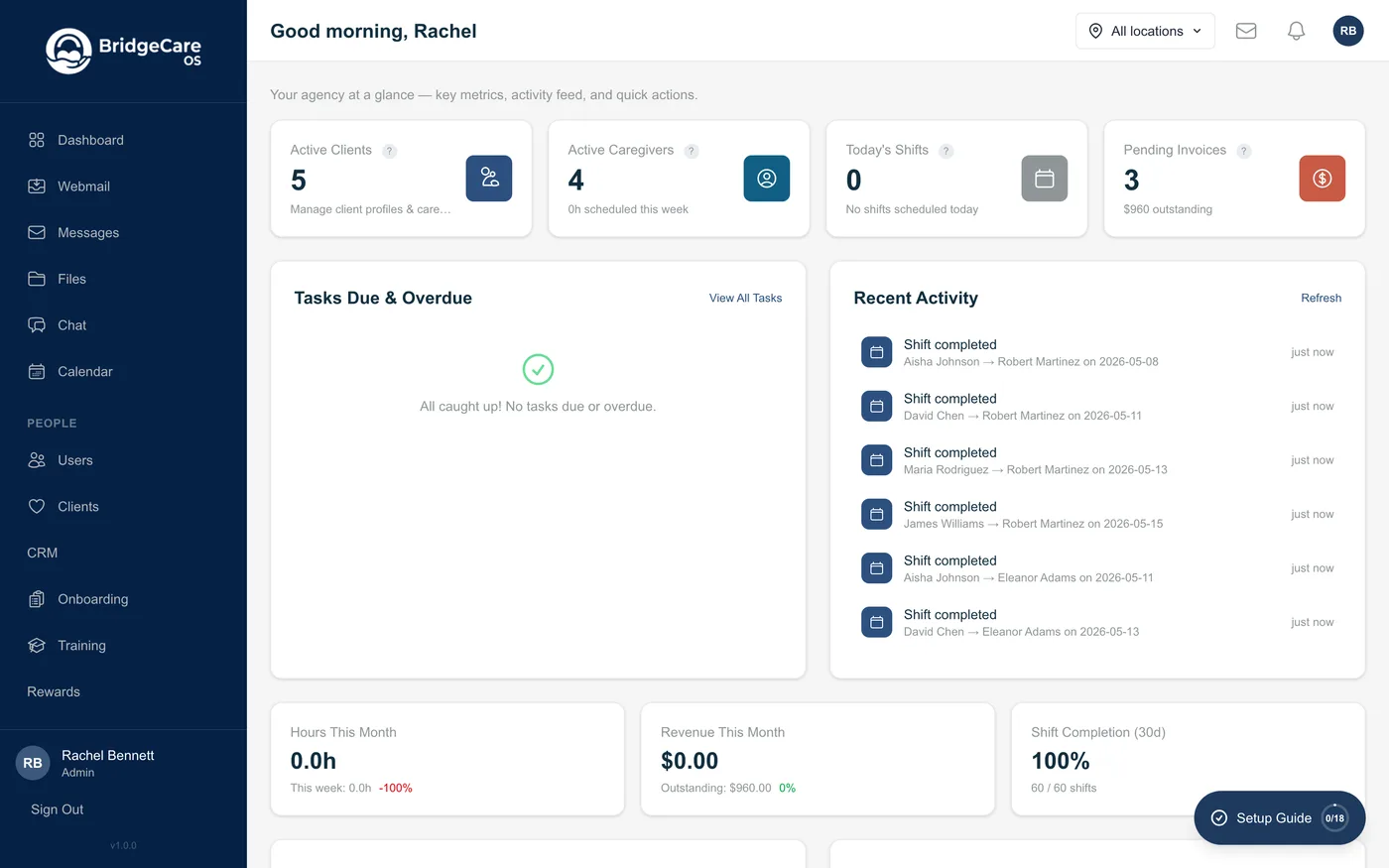
BridgeCare OS is an all-in-one home care operating system that unifies agency administrators, field caregivers, and patient families on a single platform. Built from the ground up in 2025–2026, it ships with native EVV, Medicaid EDI billing, mobile-first caregiver tools, and a family transparency portal — included on every plan, not as paid add-ons.
Pros
- Transparent, public pricing — no quote-only sales motion
- Zero setup fees, no contracts, instant trial signup
- Native family portal is rare at this price tier
- Modern UI built on a current stack (PWA, real-time updates)
Cons
- Newer platform — smaller installed base than incumbents
- Enterprise post-acute workflows still maturing vs MatrixCare
- No dedicated implementation manager on the entry tier
AlayaCare
AlayaCare is a cloud-based platform built for multi-region home and community care providers. Strong on scheduling, clinical documentation, and analytics; widely adopted by mid-to-large agencies and post-acute networks. Pricing is quote-only — typically lands in the $400–$1,000/user range with material implementation fees.
Pros
- Deep multi-region and multi-entity support
- Strong clinical documentation and reporting
- Acquisition-mode tooling for groups buying smaller agencies
Cons
- Out of reach for small agencies on price and implementation time
- Quote-only sales process — sticker-shock common
- Caregiver UX can feel heavy compared to consumer-grade apps
WellSky Home Health
WellSky (formerly Mediware/Kinnser) is the deepest legacy home-health platform in the US — strong on clinical workflows, OASIS, and value-based care reporting. Best fit for established home health agencies already paying enterprise software budgets. Sticker shock is common.
Pros
- Deepest clinical and Medicare workflows in the category
- Mature value-based care and OASIS support
- Vast partner / interoperability ecosystem
Cons
- Pricing is opaque and high; not viable for small agencies
- UI shows its age; modern caregivers expect more
- Implementation often takes 8–16 weeks
AxisCare
AxisCare is consistently top-rated on G2 for ease of use among home care platforms. Strong scheduling, client management, and telehealth integrations. Quote-only pricing usually lands in the mid-market range.
Pros
- Top G2 ratings for ease of use and admin
- Mature, stable platform
- Good caregiver mobile experience
Cons
- Quote-only pricing — slows down evaluation
- Family portal is a paid add-on
- Less feature breadth than enterprise platforms
CareSmartz360
CareSmartz360 is an end-to-end home care platform with billing, payroll, EVV, and CRM — competitive at the lower end of mid-market pricing. Strong feature breadth for the price; UI is functional rather than polished.
Pros
- Wide feature breadth for the entry price
- Integrated payroll and HR workflows
- Active vendor publishing content / comparison guides
Cons
- UI is utilitarian; caregivers may push back
- State EVV depth varies — confirm before signing
- Family portal is not a strength
Alora
Alora is a long-tenured home care platform with strong caregiver mobile workflows and reliable support. Mid-market pricing. Common pick when caregiver adoption is the primary blocker.
Pros
- Caregivers consistently rate the app well
- Mature platform, reliable uptime
- Good support reputation
Cons
- UI feels dated next to newer entrants
- Family portal is a gap
- Quote-only pricing
HHAeXchange
HHAeXchange is itself a state EVV aggregator in many markets, which makes it a natural fit for Medicaid-heavy agencies needing tight aggregator integration. Strong billing depth. Less flexible for non-Medicaid lines.
Pros
- Tightest aggregator integration if your state uses HHAeXchange
- Deep Medicaid billing workflows
- Mature platform
Cons
- Best leverage is Medicaid; less ideal for private-pay-heavy agencies
- UI is functional, not modern
- Pricing not public
MatrixCare
MatrixCare (ResMed) is an enterprise post-acute platform covering home health, hospice, skilled nursing, and senior living. Best fit for organizations with a portfolio across post-acute settings. Heavy implementation; expensive.
Pros
- Single platform across home health, hospice, SNF, senior living
- Strong enterprise reporting and analytics
- Vendor stability (ResMed backing)
Cons
- Overkill (and overpriced) for pure home care agencies
- Long implementation cycles
- UI feels enterprise-software dated
ShiftCare
ShiftCare is a lightweight home care scheduling and rostering platform popular with small agencies. Strong shift management and care notes. Lighter on EVV and US Medicaid billing depth — confirm your state requirements before adopting.
Pros
- Per-user pricing is friendly for small teams
- Caregivers like the app
- Fast setup
Cons
- Lighter on US Medicaid EDI billing
- State EVV coverage varies — confirm yours
- Less compliance documentation depth
Sandata
Sandata is — like HHAeXchange — a state EVV aggregator in many US markets, plus a full home care platform. Best fit when your state uses Sandata as the EVV aggregator and you want a single-vendor stack. Less popular as a primary agency platform outside that scenario.
Pros
- Native aggregator integration in many states
- Mature, stable platform
- Single-vendor stack appeal
Cons
- UI dated; caregiver experience not best-in-class
- Best fit is narrow (Sandata-aggregator states)
- Quote-only pricing
Side-by-side comparison
| Platform | Entry pricing | Setup fees | Family portal | Implementation |
|---|---|---|---|---|
| BridgeCare OS | $249/mo + $14/caregiver | $0 | Included | 48 hours |
| AlayaCare | Custom (enterprise) | $20K–$50K+ | Add-on | 8–12 weeks |
| WellSky Home Health | Custom (enterprise) | $20K–$400K | Limited | 8–16 weeks |
| AxisCare | Custom (mid-market) | Varies | Add-on | 2–6 weeks |
| CareSmartz360 | ~$99/mo | Low/none | Limited | 1–3 weeks |
| Alora | Custom ($100–$300/mo) | Varies | Limited | 2–6 weeks |
| HHAeXchange | Custom | Varies | Add-on | 4–10 weeks |
| MatrixCare | Custom (enterprise) | Six figures common | Limited | 12–24 weeks |
| ShiftCare | ~$25/user/mo | $0 | Limited | 1 week |
| Sandata | Custom | Varies | Limited | 4–10 weeks |
How to choose between them
Three honest filters in order:
- Filter by your state EVV aggregator first. If your state uses HHAeXchange or Sandata as the EVV aggregator, give those vendors a hard look — the integration is native, not glued on. Other platforms (BridgeCare OS, AlayaCare, WellSky, AxisCare) still ship the integrations, but the aggregator-as-vendor case is real.
- Filter by total cost of ownership over 3 years, not month one. The $99/month entry vendors often add per-feature upcharges that double the bill by year two. Enterprise vendors charge implementation fees that can equal a year of subscription. Ask for a written 3-year quote including setup, training, and every paid module before signing.
- Let your caregivers test the mobile app before you sign. Caregiver turnover is the single biggest variable cost in home care. The cheapest software that caregivers refuse to use is more expensive than the priciest software they love. Every vendor on this list will give you a trial — use it.
Frequently asked questions
What is the best home care software for small agencies in 2026?
For small home care agencies (1–50 caregivers), the best balance of price, modern UX, and complete features is BridgeCare OS from $149/month flat (up to 10 caregivers) or $249/month + $14 per caregiver — no setup fees, no contracts, 14-day free trial. AxisCare and ShiftCare are strong runners-up for usability-first teams; CareSmartz360 and Alora are competitive at similar entry prices.
How much does home care software cost in 2026?
Home care software in 2026 ranges from $99/month at the low end (CareSmartz360, ShiftCare) to enterprise contracts of $20,000–$400,000 in setup fees alone (WellSky, MatrixCare). Mid-market platforms like BridgeCare OS, AlayaCare, AxisCare, and Alora typically cost $200–$500/month base + $10–$25 per caregiver per month. Setup fees vary from zero to six figures depending on vendor.
Which home care software has the best EVV compliance?
For state EVV aggregator depth, HHAeXchange and Sandata lead because they are themselves state EVV aggregators in many markets. For agencies that need to send claims to multiple state aggregators (Sandata, HHAeXchange, Netsmart), BridgeCare OS, AlayaCare, and WellSky all ship native integrations. AxisCare and Alora cover the major aggregators well too.
Is BridgeCare OS HIPAA compliant?
Yes. BridgeCare OS is built HIPAA-ready with field-level AES-256 encryption, immutable audit logs, role-based access controls, triple MFA (TOTP, email, SMS), and SAML 2.0 / OIDC SSO. It is also SOC 2-aligned across the Trust Services Criteria. Every major platform on this list is HIPAA-compliant; the differences are in audit depth and access-control granularity.
What is the easiest home care software to set up?
BridgeCare OS, ShiftCare, and AxisCare are the easiest to set up because they ship with zero implementation fees and a self-serve onboarding flow. New agencies can typically be running scheduling and EVV within 48 hours. Enterprise platforms like WellSky, MatrixCare, AlayaCare, and HHAeXchange require 4–12 weeks of paid implementation.
Does home care software handle Medicaid billing?
Most modern home care platforms handle Medicaid EDI billing using the ANSI X12 837P claims format. BridgeCare OS, AlayaCare, WellSky, HHAeXchange, AxisCare, and CareSmartz360 all support multi-payer rate schedules, split billing between insurance and private pay, and remittance posting. The differences are in claim scrubbing depth and denial-management workflows.
Which home care software is best for caregiver experience?
ShiftCare and Alora are widely praised for caregiver UX. BridgeCare OS ships a mobile-first PWA (installs on iOS, Android, and Web) with clock-in/clock-out, shift swaps, care documentation, and direct messaging. Strong caregiver UX reduces turnover; agencies should let caregivers actually try the mobile app before buying.
Can families see what's happening with their loved one's care?
Family transparency portals are still rare in 2026. BridgeCare OS includes a native Patient & Family Portal with care plans, visit history, real-time updates, and direct messaging — included on every plan. AlayaCare and HHAeXchange offer family portals as paid add-ons. Most other platforms do not include a family-facing surface at all.