Medicaid claims that get paid the first time
Medicaid billing is where home care agencies leak money. Wrong service codes, missing authorizations, expired modifiers, EVV-missing visits, duplicate claim lines — every one a denial, every denial a delayed payment. BridgeCare OS ships ANSI X12 837P claims generation, multi-payer rate schedules with effective dates, claim scrubbing before submission, and automatic 835 remittance posting. Included on every plan.
What it is: ANSI X12 837P (the HIPAA-mandated electronic claim format) for Medicaid and other professional-services payers, with the supporting machinery — authorizations, rate schedules, claim scrubbing, denials, remittances.
What BridgeCare ships: native 837P generation from EVV-verified visits, multi-payer rate schedules with effective-date ranges, automated claim scrubbing, denial workflow, 835 ERA auto-posting, split billing.
Why it matters: first-pass claim acceptance rate is the single most controllable variable in home care cash flow. Catching errors before submission beats appealing them after denial — every time. That's exactly what Claim Readiness does: a pre-bill audit on every visit before it becomes a claim.
What the billing engine actually does
837P claim generation
Native ANSI X12 837P file generation from completed, EVV-verified visits. Sends to state MMIS, MCO portals, or clearinghouses.
Multi-payer rate schedules
Per-payer rate tables with service codes, modifiers, and effective-date ranges. Visit billing rate is the active rate for that service on that date.
Authorization tracking
Patient authorizations linked to payers, services, units, and date ranges. Visits without active authorization are flagged before billing.
Claim scrubbing
Validation against payer rules before submission — missing auth, expired auth, units overage, wrong modifier, missing EVV, duplicates.
Denial management
Denial reasons attached to claims, queued for biller review, with one-click rebill, appeal, or write-off workflows.
835 remittance posting
Electronic Remittance Advice (ERA) auto-posts paid amounts, adjustments, and patient responsibility to the patient ledger.
Split billing
Insurance + private pay combinations, multi-payer claims, family-payable balances routed to the family portal.
Audit-grade trail
Every claim change, scrub finding, denial, and rebill is logged with who/what/when/why. CMS-compliant audit readiness.
How a clean billing cycle runs
- Visit completed. EVV captured, care notes submitted, supervisor sign-off (if required by the agency).
- Visit qualified for billing. System verifies active authorization, units within authorized amount, EVV present, service code matches authorization.
- Claim batch built. Biller selects a payer + date range. System assembles all eligible visits into a single 837P file.
- Scrub run. Each claim line validated against the payer's rule set. Findings shown line-by-line; biller fixes or excludes flagged claims before submission.
- Submission. 837P file transmitted to the MMIS, MCO portal, or clearinghouse. Transmission timestamp logged.
- Acceptance (277CA). Payer's claim-acceptance response posts back to the claim record. Rejections flagged for fix.
- Payment (835 ERA). Electronic remittance auto-posts paid amounts and adjustments. Patient ledger updated.
- Reconciliation. End-of-period reports show paid, denied, pending, and aging by payer. Biller works the denied queue.
Why first-pass acceptance matters
Industry-average first-pass claim acceptance for home care Medicaid sits in the 80–88% range. Every denied claim represents a 30–60 day delay in payment and several minutes of biller time to rework. BridgeCare OS pushes first-pass acceptance higher by catching the controllable errors — missing auth, EVV-missing, wrong modifier — at scrub time, before submission.
For an agency billing $200K/month in Medicaid services, moving from 85% to 92% first-pass acceptance means about $14K/month no longer floating in the denial queue. Over a year, that's $168K of cash flow back in the agency's hands, plus the biller time saved on rework.
EVV ↔ billing reconciliation
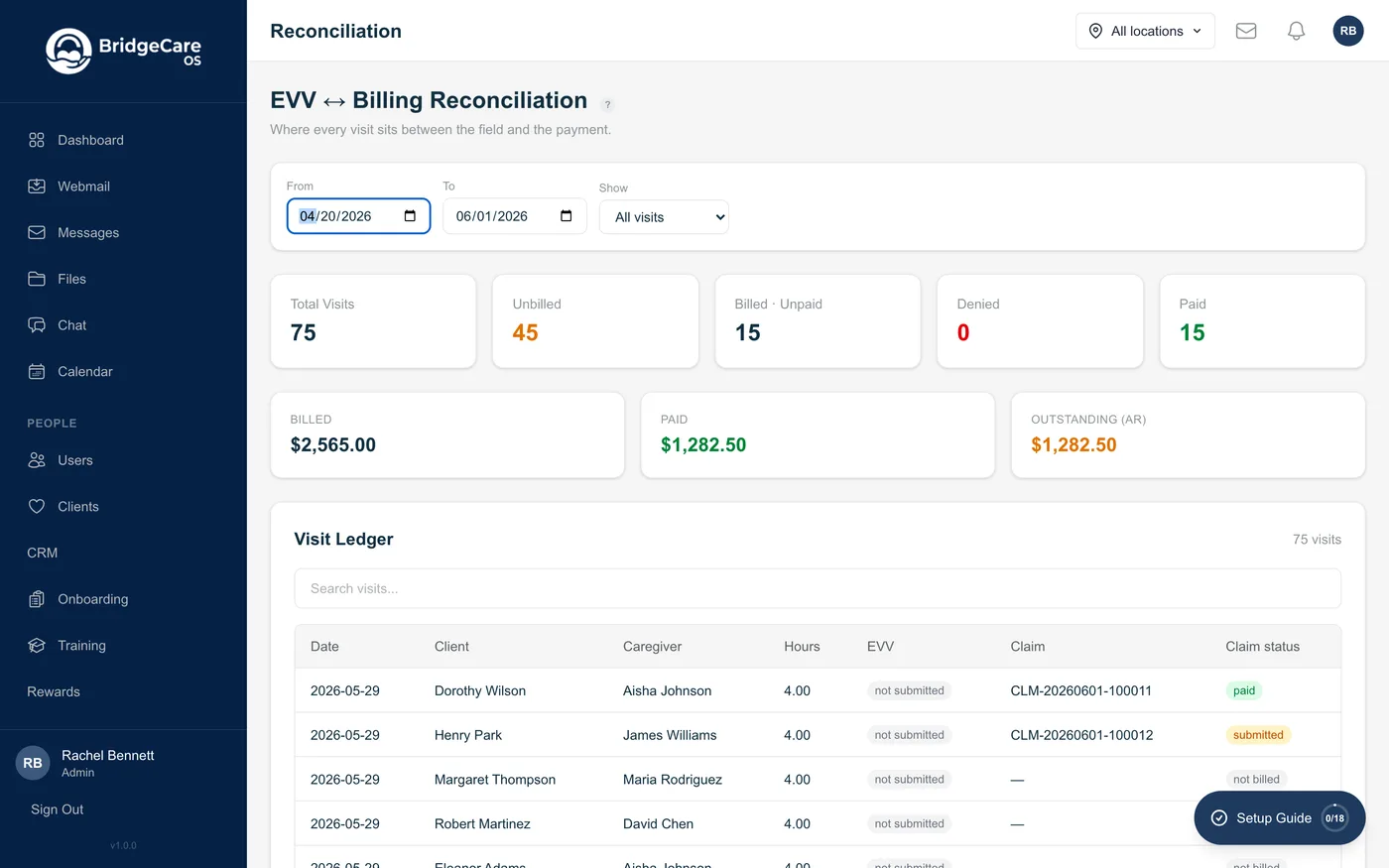
The money agencies lose isn't only denials — it's visits that quietly never get billed, and claims that get billed and then forgotten. BridgeCare OS tracks every completed visit through its full revenue lifecycle so nothing slips through the cracks:
Submitted
The visit's EVV status — accepted by the state aggregator, rejected, or not yet submitted.
Billed
Which claim the visit is on, and that claim's status. Visits with no claim are flagged as unbilled — revenue you've earned but haven't invoiced.
Paid
Billed-but-unpaid visits roll up into a live accounts-receivable figure, so you can see exactly how much is outstanding and chase it.
The reconciliation view buckets every visit into unbilled, billed & unpaid, denied, or paid, with dollar totals for each — turning "did we bill everything?" from a quarterly spreadsheet panic into a one-screen answer. And because each visit is locked to a single claim, the same visit can't be billed twice.
Frequently asked questions
What is ANSI X12 837P?
The HIPAA-mandated electronic claim format for professional services, including home and community-based services billed to Medicaid. Every Medicaid agency submits claims in this format — directly to their state MMIS, through an MCO portal, or via a clearinghouse. BridgeCare OS generates 837P files natively.
Does BridgeCare OS handle Medicaid billing?
Yes. Generates 837P claims directly from EVV-verified visits, supports multi-payer rate schedules with effective-date ranges, runs claim scrubbing, handles denial workflows, posts 835 remittance automatically.
How does BridgeCare OS handle multi-payer rate schedules?
Each payer (Medicaid, MCO, Medicare, private pay, VA, LTC insurance) has its own rate schedule with service codes, modifiers, and effective-date ranges. Visit billing rate is the active rate for that service on that date. Rate changes update prospectively.
What is claim scrubbing?
Automated validation of a claim against payer rules before submission. BridgeCare OS scrubs for missing/expired authorizations, units overage, mismatched diagnoses, missing modifiers, EVV-missing visits, and duplicates.
How does denial management work?
Denial reasons attached to claims, queued for biller review, one-click rebill/appeal/write-off workflows. Common denials trigger automatic fix-and-rebill where data can be corrected.
Does BridgeCare OS post remittances automatically?
Yes. 835 ERA files auto-post paid amounts, adjustments, and patient responsibility to the patient ledger. Underpayments flagged for review.
How do I find visits I never billed?
The EVV ↔ billing reconciliation view tracks every completed visit through submitted → billed → paid and buckets them into unbilled, billed-and-unpaid, denied, and paid — with dollar totals. Unbilled visits are earned revenue you haven't invoiced; the billed-and-unpaid bucket is your live accounts receivable. Each visit is locked to a single claim, so the same visit can't be billed twice.
What about split billing — insurance plus private pay?
Native support. The visit is split into appropriate claim lines, 837P generated for the covered portion, private-pay invoice created and routed to the family portal.
Which payers does BridgeCare OS support?
State Medicaid (direct or via clearinghouse), Medicaid MCOs, Medicare (limited), private pay, LTC insurance carriers, VA, workers' comp. Adding a new payer means rate schedule + EDI endpoint setup.
Related features
Claim Readiness pre-bill audit · Electronic Visit Verification · Reports & analytics · Best home care billing software 2026