AI that does the work auditors and coordinators do
Most "AI" in home care software is a chatbot bolted onto a sidebar. BridgeCare OS puts AI where it actually saves money and protects patients — reviewing a visit's documentation against the care plan before an auditor sees it, scoring hospitalization risk, catching care decline, and forecasting staffing and burnout. It runs per agency on your own AI key, so you control the model, the cost, and the data.
What it is: practical AI built into the platform — documentation-gap review against the care plan, hospitalization-risk scoring, care-decline detection, staffing and burnout forecasts, document extraction, and care-plan recommendations.
What's rare: the AI documentation-gap review reads each visit note against the client's care plan and flags audit risk — most competitors' AI only extracts or summarizes documents.
How it runs: per agency, on your own Anthropic or OpenAI key. You control the model and the cost; results are cached so you're not paying to re-run the same analysis.
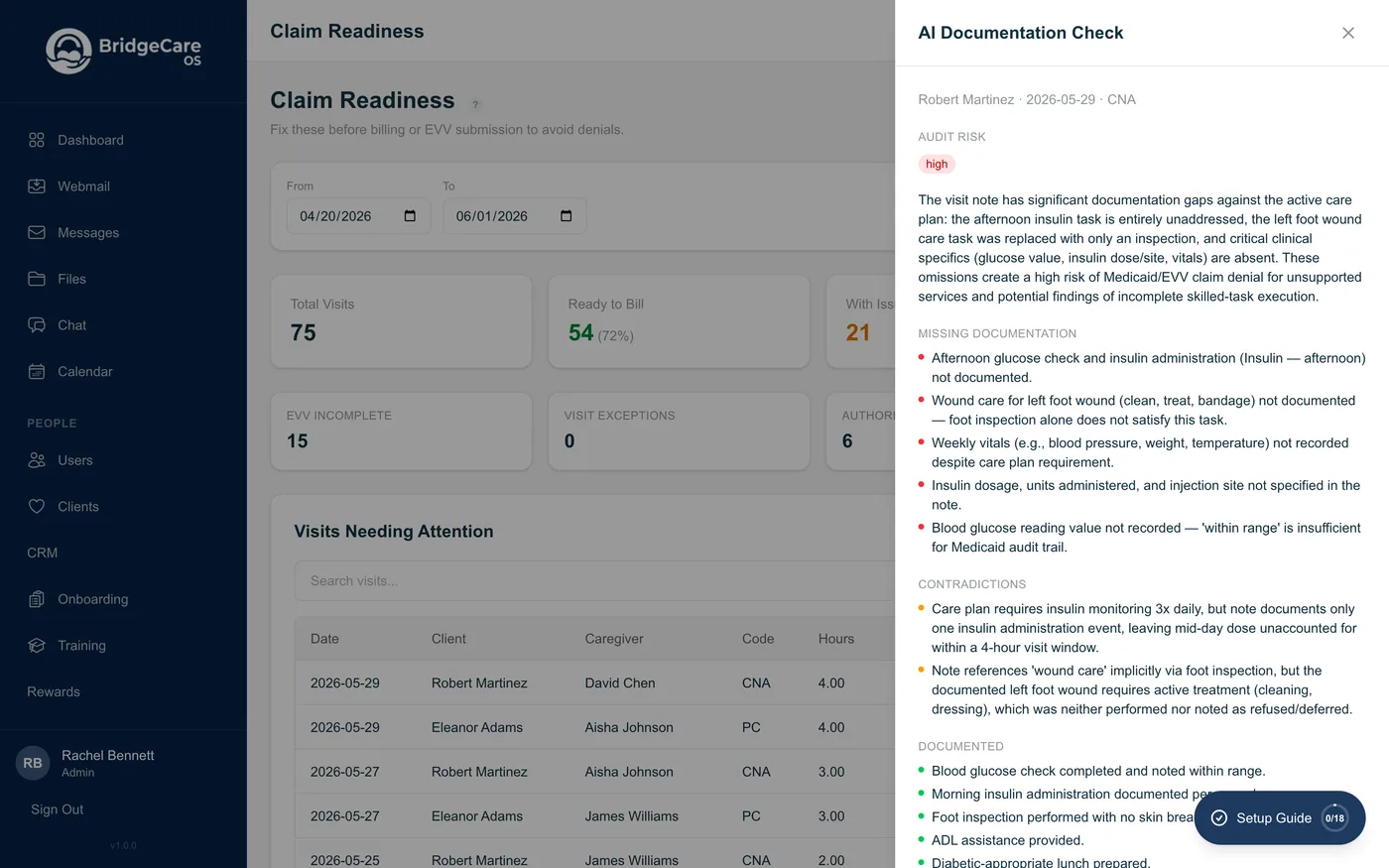
The AI that pays for itself: documentation-gap review
The most expensive denials and audit findings in home care come from documentation — a visit note that doesn't evidence the care plan, or contradicts it. That problem hides in free text, which is exactly what AI is good at reading. BridgeCare OS compares each visit's caregiver note against the client's care plan and returns a structured review:
Missing documentation
Planned care-plan activities the note doesn't evidence — the gaps an auditor would flag.
Contradictions
Anything in the note inconsistent with the plan or the authorization.
Audit-risk rating
Low, medium, or high, with a one-line summary — so a reviewer knows where to look first.
What's documented
The activities the note does support, so you can see the visit is defensible.
It's part of the Claim Readiness workflow — runs on demand per visit, caches the result, and uses your own AI key. Few platforms in this segment offer it.
Predict and prevent, not just report
The rest of the AI turns the data your agency already captures into early-warning signals — so coordinators act before a problem becomes a hospitalization, a callout, or a lost caregiver.
Hospitalization-risk scoring
Each patient scored on relative risk from visit notes, care-plan changes, missed visits, and documented decline — so coordinators prioritize attention.
Care-decline detection
Patterns across recent visits that suggest a client is declining, surfaced as an alert before the next crisis.
Staffing forecasts
Projected staffing needs from your scheduled demand, so you recruit ahead of the gap instead of scrambling.
Burnout prediction
Caregivers trending toward overload — long hours, back-to-back visits — flagged before they quit.
Cost-anomaly detection
Unusual cost or utilization patterns surfaced for review before they erode margin.
Document extraction & care plans
OCR + structured extraction from referral packets and faxes, plus AI-assisted care-plan recommendations from the client's history.
On your terms: your model, your key, your data
AI in healthcare is a data-handling decision, not just a feature. BridgeCare OS is built so that decision stays yours:
- Your own AI provider key — connect Anthropic Claude or OpenAI. You choose the model and pay your provider directly, so cost is transparent.
- Minimum-necessary context — each analysis sends only what it needs (for a documentation review, one visit note plus the relevant care plan), not your whole database.
- Graceful degradation — no key configured? The platform works exactly the same; AI features simply show a "not configured" state.
- Per-agency configuration — every agency controls its own AI settings; on a white-label deployment, each tenant brings its own.
Frequently asked questions
What can AI do in home care software in 2026?
The high-value uses are operational and clinical: reviewing a visit's documentation against the care plan to catch audit-risk gaps, scoring hospitalization risk, detecting care decline, forecasting staffing and burnout, and extracting structured data from referrals. BridgeCare OS ships all of these built in, per agency.
Can AI review home care visit documentation?
Yes. BridgeCare OS compares a caregiver's note against the care plan and returns the planned activities not evidenced, any contradictions, and an audit-risk rating. This note-vs-plan auditing is rare in the small-to-mid market, where most AI only extracts or summarizes documents. It runs on demand per visit and caches the result.
Does BridgeCare OS use my own AI provider?
Yes — AI is configured per agency on your own Anthropic Claude or OpenAI key, so you control the model, the cost, and the data-processing relationship. The rest of the platform works the same whether or not AI is enabled.
Is AI in home care software HIPAA-safe?
It can be, scoped correctly. BridgeCare OS runs AI on your own provider key, sends only the minimum context for a specific analysis, and keeps everything else in your tenant. Put a business associate agreement in place with your AI provider, as with any vendor that processes PHI.
Can AI predict hospitalizations?
AI can estimate relative hospitalization risk from signals you already collect and flag care decline, so coordinators intervene earlier. These are decision-support signals to prioritize attention, not clinical diagnoses.
How much does the AI cost?
The features are included; you pay your AI provider directly through your own key, and results are cached where appropriate so you're not re-running the same analysis. Costs stay transparent and under your control.
Related features
Claim Readiness denial prevention · Reports & analytics · Medicaid billing